
Training
AI literacy training for employers in Ireland and the UK
Programmes that give your staff the knowledge and judgement to use AI tools well, and give you a record of the training. Article 4 of the EU AI Act, as amended in July 2026, requires employers that use AI to take measures to build their staff’s AI literacy. We provide training support, not legal advice.
- Who it’s for
- Employers whose staff use AI tools
- What you get
- Sessions, records, policy and refreshers
- Delivered
- On site or online, by role
- Start with
- Team AI Literacy Workshop
What Article 4 asks of employers
Article 4 of the EU AI Act requires providers and deployers of AI systems to take measures to build the AI literacy of their staff and others using AI on their behalf. The duty has applied since 2 February 2025 and was amended in July 2026 by the Digital Omnibus on AI. Organisations must still take measures, but no longer have to guarantee a set level for each person.
A deployer is, broadly, an organisation using an AI system in its work. If your staff use ChatGPT, Microsoft Copilot, Gemini or AI features inside your software, the duty may well be relevant to you.
Good AI literacy training takes account of people’s knowledge, experience and how they use AI. That is why we build it around roles, not one session for everyone.
We provide training, records and policy support, not legal advice. For how the Act applies to you, talk to your solicitor or adviser.
What an AI literacy programme includes
Needs assessment
We find out which AI tools are in use, officially or not, who uses them, for what and with what data.
Role-based sessions
Separate sessions for leadership, client-facing staff, finance and admin, and the people who set up AI tools, each using real tasks from that role.
AI use policy
A plain-English policy template covering approved tools, data rules, checking outputs and disclosure, adapted with you and adopted as your own.
Training records
Attendance records for each session: who attended, when, the format and the topics covered, ready for your training file.
Follow-up resources
Prompt guides, checklists and quick-reference sheets for each role, so learning carries into everyday work.
Refreshers
Short refresher sessions when tools change, new staff join or your policy is updated.
What your people learn
- How ChatGPT, Microsoft Copilot and Gemini work, what they are good at and where they go wrong.
- Writing clear prompts for drafting, summarising, research and analysis.
- Checking outputs for errors, invented facts and bias before anyone relies on them.
- What data can and cannot go into an AI tool, including personal and client data under GDPR.
- When to tell colleagues, clients or the public that AI was used.
- What to do, and who to ask, when something goes wrong.
- For leadership: which tools to approve, how to weigh the risks and what records to keep.
How a programme runs
Step 1
Assess
A short survey and conversations with managers show which tools are in use, by whom and with what data.
Step 2
Design
We group people by role, choose real tasks for the exercises and draft the AI use policy with you.
Step 3
Deliver
Role-based sessions on site or online, with demonstrations, hands-on practice and questions.
Step 4
Record and refresh
You receive attendance records and resources, and we schedule refreshers when tools or policies change.
Where this training comes from
We delivered 86+ training sessions in 2025, for professional bodies, Skillnet networks, Local Enterprise Offices and employers.
Motor industry
SIMI Skillnet programmes
AI and digital training delivered on SIMI Skillnet programmes for the motor industry, built around the tools and tasks of the businesses taking part.
Professional bodies
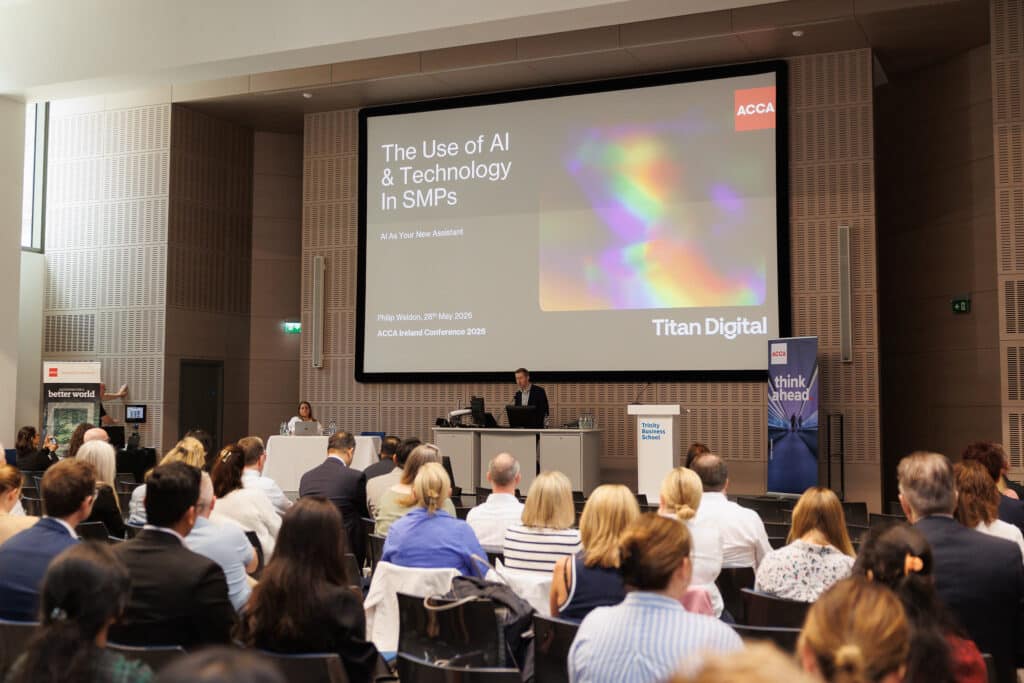
Philip Weldon speaks on AI at ACCA Ireland events, including the Annual Conference 2026, and runs an AI for Accountancy Practices session.
Local enterprise
Digital tools training for Local Enterprise Office clients in Dublin City, South Dublin and Fingal.
Ways to start
Start with one team, or plan a programme across your organisation. Every option is scoped in writing before we begin.
The essentials for one team in a half or full day, with a fixed scope, records and a policy template.
For larger organisations: needs assessment, sessions across departments, a policy and refreshers, scheduled around your operations.
Once your team is confident, find where AI and automation will save the most time, with a costed 90-day roadmap.
Keep exploring
Related pages
Common questions
Does Article 4 apply to small businesses?
Article 4 refers to providers and deployers of AI systems. How it applies to your organisation is a question for your solicitor or adviser. Either way, the same skills reduce mistakes and help people use the tools well.
Is there a required course or certificate?
Article 4 does not set out a specific course or certificate. We provide attendance records and materials that show what training took place.
Can you write our AI use policy for us?
We provide a plain-English template and adapt it with you in a working session. The final policy is yours to adopt, and your adviser can review it if needed.
How long does a programme take?
It depends on the number of roles and people. A single team can cover the essentials in a half or full-day workshop; larger organisations usually run a series of sessions over several weeks.
Do you train UK teams?
Yes. We run AI literacy programmes for employers in Ireland and the UK, on site or online. UK employers use them to upskill staff and set clear rules for AI use.
Is this legal advice?
No. We provide training, records and policy templates. For legal interpretation, talk to your solicitor or adviser.
Build AI literacy across your team
Book a call to talk through your tools, your roles and your timeline. You will get a proposal for a programme that fits.